Self-Diagnosis · 9 min read · June 2, 2026
10 Signs You Need a Better Espresso Dialing-In System (Not Better Beans)
Every home barista has been here: you crack open a gorgeous new bag of single-origin beans, pull your first shot, and it tastes like sucking on a copper coin. You adjust. Then over-adjust. By shot seven you've wasted nearly 130 grams of a $22 bag and you're Googling "why does my espresso taste wrong." The bad news is that the beans probably weren't the problem — your dialing-in system was. Below are 10 signs that your approach needs an upgrade, not your next bag.
- You're burning shots on every new bag: A systematic approach should reach a drinkable shot in 3–5 pulls; most home setups burn 2–6 before tasting anything worth drinking [1].
- You're changing multiple variables at once: Adjusting grind size, dose, and yield simultaneously makes it impossible to know what actually changed the flavor [2].
- You're ignoring taste as primary feedback: Chasing a 25-second pour time while ignoring sour or bitter notes means you're timed, not dialed in [3].
- The math is hurting your wallet: Specialty beans cost $0.75–$1.25 per shot; a chaotic dial-in of even 6 wasted shots is $4.50–$7.50 straight in the sink [4].
- You have no record of what worked: Without documentation, every new bag starts completely from scratch [2].
- Your manual grinder adjustments feel like guesswork: Without a structured protocol, each click of the burr ring is a coin flip rather than a deliberate move [5].
| Sign | Root Cause | What to Fix |
|---|---|---|
| Shots sour every time on new bag | Under-extraction / grind too coarse | Adjust grind finer first, one step at a time |
| Shots bitter then sour in same session | Changed dose AND grind together | Lock dose; change only one variable per shot |
| Good shot on day 2, gone by day 5 | No notes; beans degassing | Log grind setting + days-off-roast per shot |
| Waste 25–30% of bag dialing in | No starting reference recipe | Use 1:2 ratio baseline every new bag |
| "Fixed" one problem, created two new ones | Multi-variable changes | Single-variable protocol; taste between each shot |
| Frustrated, swapped beans, still bad | System issue, not bean issue | Structured taste-feedback loop |
TL;DR: If opening a new bag routinely costs you more than 3–4 shots and your best setting from last week doesn't transfer, you don't need better beans — you need a better dialing-in system.
Signs 1–3: The Waste Problem Is Real (and It's Costing You Money)
Sign 1: You Routinely Trash the First 4–6 Shots of Any New Bag
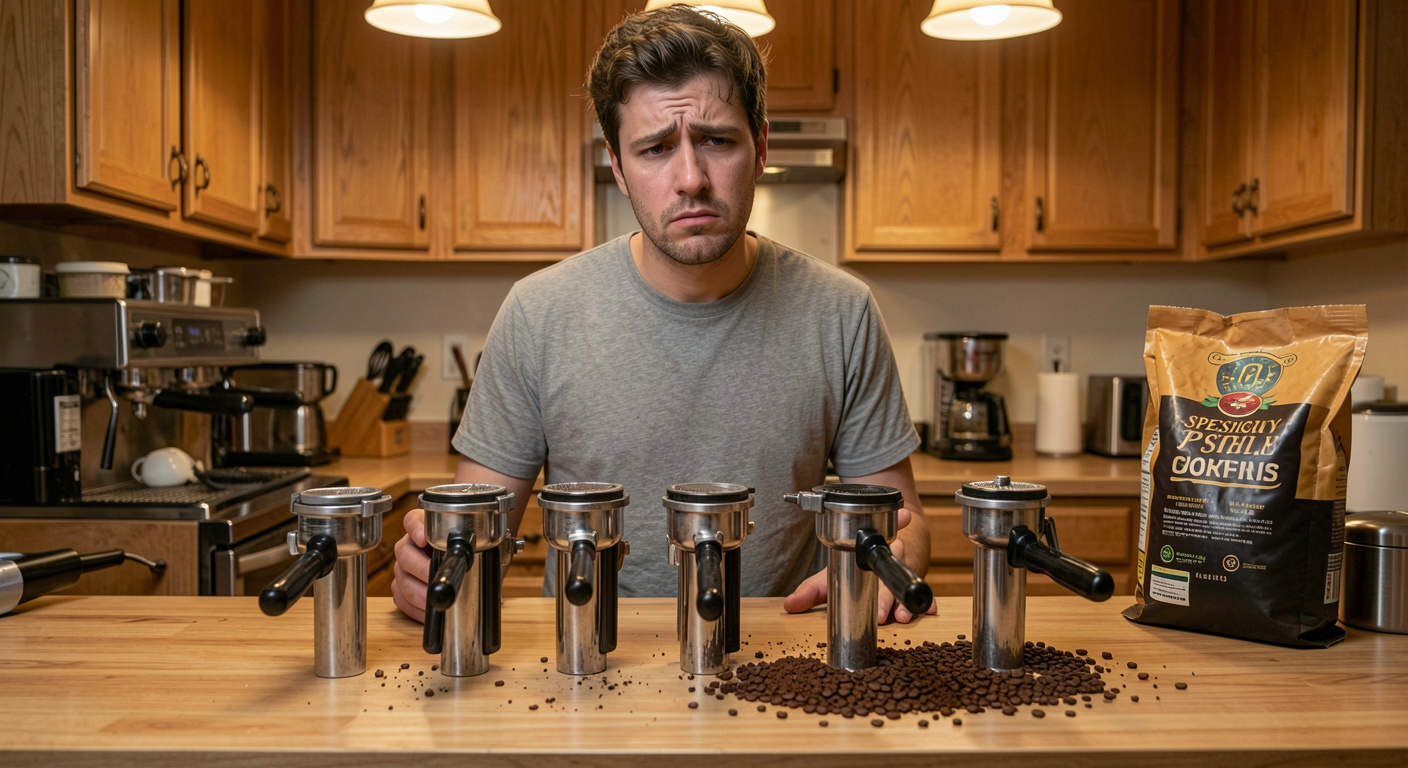
Home barista forums have been logging this frustration for years. On a popular Home Barista thread, users reported routinely going through "at least a quarter pound" just getting to a drinkable baseline on a new coffee — that's roughly 113 g of beans [5]. At a dose of 18 g per double shot, a quarter pound gets you only about six shots before the bag is 25% gone.
Do the math in dollars: a quality 12-oz specialty bag typically runs $15–$25 [4]. A 12-oz bag yields roughly 20–30 double shots at an 18 g dose — meaning each shot costs $0.75 to $1.25 in beans alone [4]. Pouring six of those down the drain without tasting a single worthwhile cup is $4.50–$7.50 gone before you've had your morning coffee.
"In professional training, numbers exist to make quality repeatable — especially in high-volume service. If your shots 'hit the time' but taste wrong, your process is not dialed in — it is merely timed." — Espresso Academy, Barista Training Division [3]
According to analysis of home-brewing math, dialing-in shots on a new coffee at an 18 g dose burns between 36 g and 108 g of beans — representing 4–11% of a full kilogram just on the tuning phase alone [1]. Multiply that across a year of monthly bag rotations and you're looking at half a bag of premium beans wasted annually — purely on a broken process.
Sign 2: You're Always Swapping Beans When the Problem Is Your Protocol
This is the sneakiest trap in home espresso. The bag gets blamed. You chase a new origin, a new roaster, a different roast level — and the exact same frustration follows you. It's not the beans. It's that without a structured starting recipe, every bag presents the same chaos.
The real tell: if your shots improved when you opened a bag you'd used before — not because those beans are better, but because you already had a grind setting written down — your system is the issue, not your taste in coffee. Learn how to approach a new bag with a three-shot method instead of the open-ended spiral.
Sign 3: You Spend 45 Minutes on a Weekend Dial-In and Still End Up Compromising
Time waste matters as much as bean waste. A chaotic dial-in that spans 45 minutes and six shots doesn't just burn coffee — it burns motivation. The baristas who dial in fastest share one habit: they decide what is fixed before they pull the first shot. Dose, yield target, and temperature are constants; grind size alone gets adjusted [3]. That single-variable discipline compresses 45-minute sessions into 15-minute ones.
Signs 4–6: The System Breakdown Is in Your Workflow
Sign 4: You're Changing More Than One Variable Per Shot
This is the single most documented mistake in espresso dialing-in, and it's the root cause behind dozens of secondary frustrations. Barista Life's training documentation identifies it clearly: "Adjusting grind size, dose, and timing simultaneously prevents clear cause-and-effect understanding" [2]. When you tweak two or three things between pulls, you have no idea which change fixed — or broke — the shot.
The professional approach: lock your dose and yield target, then move grind size one increment at a time and taste the result before touching anything else [3]. Only once grind is optimized do you revisit dose or ratio. This methodical loop is what separates a 3-shot dial-in from a 10-shot one.
| Adjustment Order | Variable | Move If… |
|---|---|---|
| Step 1 | Grind size | Shot tastes sour (go finer) or bitter (go coarser) |
| Step 2 | Yield / brew ratio | Balanced but too intense → increase yield; too flat → decrease |
| Step 3 | Dose | Only after grind + ratio are dialed; adjust for body/strength |
| Step 4 | Brew temp | Last resort for very light or very dark roasts |
Understanding why a shot tastes the way it does is half the battle — check out our guide on sour vs. bitter espresso to train your palate before your next dial-in session.
Sign 5: You Skip Recording What Worked
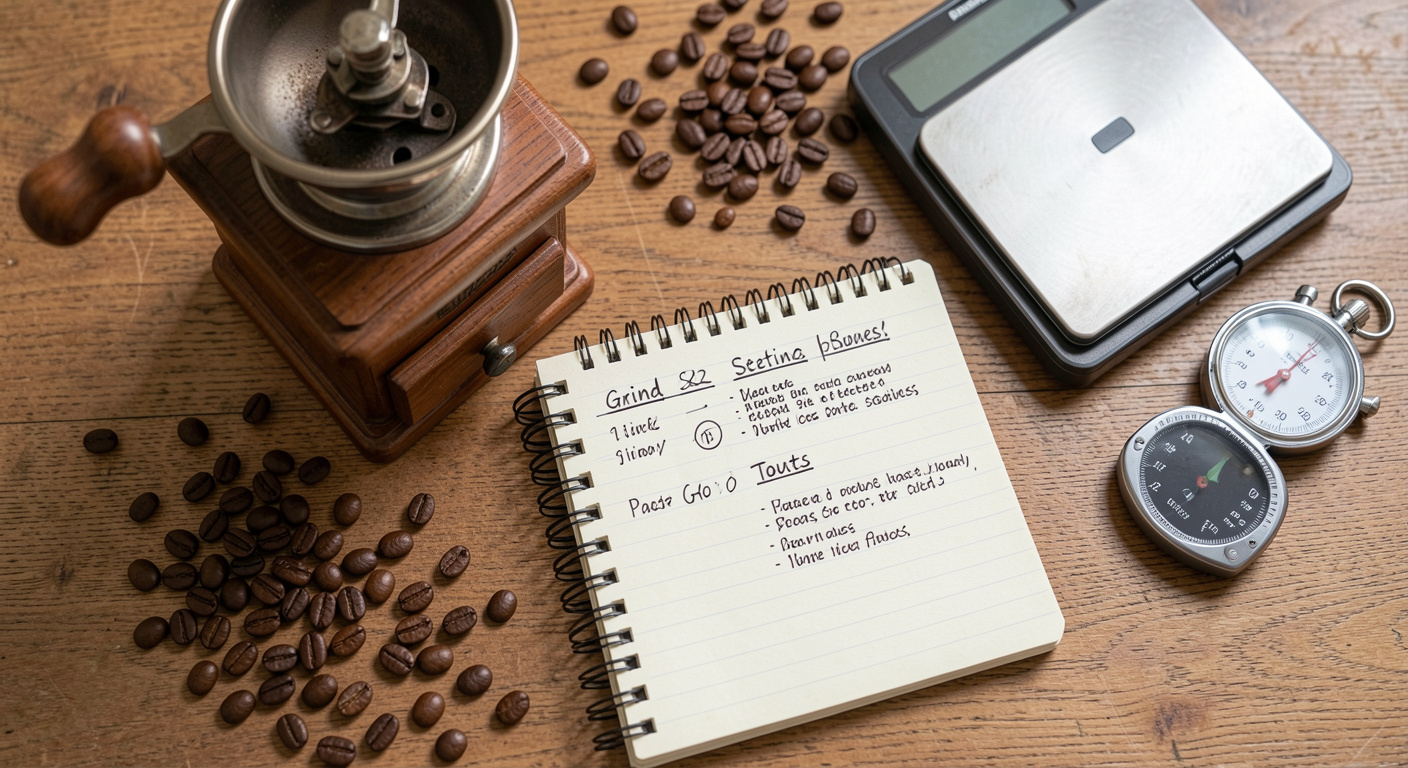
Ask yourself honestly: when you pulled the best shot you've ever made, did you write down the grind setting, dose, yield, and days-off-roast? If the answer is no, that shot is gone forever. The next bag — even the same coffee from the same roaster — will behave slightly differently, and you'll have zero baseline to build from.
Perfect Daily Grind's dialing-in guide notes that experienced baristas always track their brew parameters, because small shifts in humidity, bean age, and ambient temperature mean the grind that was perfect on Monday may need a half-step adjustment by Thursday [6]. Without notes, you can't make micro-corrections — you're starting from zero every single time.
Sign 6: Your Manual Grinder Adjustments Feel Like Random Clicks
A quality manual grinder is an extraordinary tool for home espresso — but only when you're using it with a protocol that matches its precision. The 5 manual grinder mistakes that kill espresso dial-ins are almost always system problems, not equipment problems: inconsistent grind amounts, not zeroing the burrs between sessions, or making adjustments without purging retained grounds first.
The grinder is actually the most responsive variable in your setup. My Coffee Explorer's dialing-in guide puts it directly: "Dialing in is not about memorizing numbers. It is about developing a feedback loop between what you taste and what you adjust." [7] Every click on a manual burr grinder should be a deliberate response to a specific taste observation — not a guess.
Signs 7–9: The Taste Feedback Loop Is Missing
Sign 7: You Judge Shots by Time, Not Flavor
A 27-second shot is not automatically good. A 35-second shot is not automatically bad. Brew time is a proxy indicator, not the goal. Most specialty cafés target brew times between 25 and 32 seconds as a starting framework, but the extraction window varies significantly by roast level, bean density, and dose [6]. If you're watching the clock and not tasting the cup, you're optimizing the wrong thing.
The professional standard, as defined by the Espresso Academy, is to use a "fixed baseline recipe, pull a shot, taste and observe, then adjust grind first" — with flavor always in the driver's seat [3]. Timing informs, but taste decides.
"Dial-in fails when baristas change multiple variables at once. Use a fixed baseline recipe, pull a shot, taste and observe, then adjust grind first." — Espresso Academy, Professional Barista Workflow Guide [3]
Sign 8: You Don't Know How to Translate a Taste Into a Grind Adjustment
Sour = under-extracted = typically too coarse or too short. Bitter = over-extracted = typically too fine or too long. This is the core taste-to-adjustment map, and it's what separates a dialed-in barista from someone who just pulls shots and hopes. When you can taste a shot, name the problem precisely (sharp citric sourness vs. flat, watery sourness, for example), and make a single targeted adjustment, you're using a system — not just winging it.
Espresso Aficionados' beginner framework formalizes this: the three main adjustment variables are dose, brew ratio, and grind size, each producing distinct and predictable flavor changes [8]. Knowing which lever to pull — and only that lever — is the entire game.
Sign 9: You're Thrown Off Every Time You Switch Roast Levels
Moving from a medium-developed Ethiopian to a dark-roasted Italian blend and using the same grind setting is a guaranteed way to pull terrible shots. Light roasts are denser and require a finer grind and often higher temperature; dark roasts are more soluble and extract faster, typically requiring a coarser setting or shorter yield [6]. If you don't have a protocol that accounts for this, every roast-level switch sends you back to square one.
This is especially true for home baristas rotating through seasonal offerings from specialty roasters. Light roast vs. dark roast espresso adjustments require distinct starting parameters — not the same baseline you used last month.
Sign 10: Every New Bag Feels Like Starting Over — Because You Are
This is the culminating sign that your system needs an upgrade. A good dialing-in framework should be transferable. That means you can open a bag of beans you've never used before, apply a structured starting recipe — 1:2 ratio, dose appropriate for your basket, grind starting in the medium-fine range — pull 3 shots with single-variable adjustments based on taste, and be drinking excellent espresso by shot four [7].
The "Starting Over" Trap Explained
When home baristas report routinely burning through six, eight, or ten shots on every new bag, it's almost never a beans problem. The analysis is consistent across professional training sources: "Dial-in fails when baristas change multiple variables at once" [3]. Without a stable protocol, each new bag resets to full chaos because there's no systematic starting point.
Compare this to the community benchmark: experienced home baristas on the Home Barista forum report reaching "a reasonably balanced, good-tasting shot" in no more than 3–4 shots when they have a defined process and know their equipment [5]. Two to six shots for a full dial-in is the range for structured practitioners [1]; open-ended tinkering can consume most of a small bag.
What a Better System Actually Looks Like
A genuine dialing-in system has three components: a fixed starting recipe (so you're not guessing from zero), a single-variable adjustment protocol (grind first, then ratio, then dose), and a taste-feedback decision tree (sour → finer/longer; bitter → coarser/shorter; balanced but flat → adjust ratio). That's it. The beans don't change; the process does.
As an added benefit, this approach is especially powerful for manual grinder users, where each burr adjustment is precise and repeatable. The grinder is your most responsive tool — you just need a framework that tells you exactly which direction to move it and by how much, based on what you just tasted.
If you recognize yourself in 3 or more of these signs, the good news is the fix is methodological, not financial. You don't need a new grinder, a new machine, or a new favorite roaster. You need a pocket-sized coaching system that takes your taste feedback — sour, bitter, balanced but weak — and tells you exactly which variable to change on the next shot. That's exactly what our espresso dialing-in coach is built to do: get any new bag dialed in within 3 shots, without wasting your beans or your morning.
Frequently asked questions
How many shots should it take to dial in a new bag of espresso?▾
With a structured single-variable protocol, most experienced home baristas reach a drinkable, well-balanced shot in 3–5 pulls on a new bag. Without a system, community reports suggest it's common to burn 6–10 shots or more before reaching a consistent result.
Why does my espresso taste different every time even with the same beans?▾
Inconsistency usually comes from changing multiple variables between shots (grind, dose, and yield at the same time), not logging what worked, or failing to account for how beans behave differently as they degas over days off roast. A single-variable adjustment protocol solves most of this.
How much money am I wasting by not having a dialing-in system?▾
Specialty beans cost roughly $0.75–$1.25 per double shot. If you're burning 6 shots dialing in each new bag and switching bags monthly, that's $54–$90 per year in wasted beans — just from a broken process, not bad coffee.
Should I change grind size or dose first when dialing in espresso?▾
Always adjust grind size first. It's the most impactful variable for extraction and produces the clearest cause-and-effect taste change. Only after grind is dialed should you revisit dose or brew ratio.
Does dialing in change as a bag ages?▾
Yes. As beans degas (release CO2 after roasting), their solubility increases — meaning a grind setting that was perfect on day 3 off roast may extract too fast by day 14. Logging settings with the date and days-off-roast lets you make predictable micro-adjustments instead of re-dialing from scratch.
Can I use the same dial-in settings for light and dark roast espresso?▾
No — roast level significantly changes bean density and solubility. Light roasts are denser and typically require a finer grind and higher temperature; dark roasts extract faster and usually need a coarser setting or shorter yield. Always adjust your starting parameters when switching roast levels.
Sources
- How Many Espresso Shots In 1 Kg Of Beans? | Dose Math
- Common Espresso Dialing In Mistakes Every Barista Should Avoid – Barista Life
- How to Dial In Espresso: A Professional Barista Workflow + Troubleshooting – Espresso Academy
- What Is the Average Cost of a High-end Shot of Espresso Made at Home? – Ultima Cosa
- How much coffee do you go through when dialing espresso in? – Home Barista Forum
- A Guide To Dialling In Espresso – Perfect Daily Grind
- Dialing In Espresso: A Barista's Guide to Perfect Extraction Every Time – My Coffee Explorer
- Dialling In Basics – Espresso Aficionados
Keep reading
Ready to see it for yourself?
Back to home →